

 +91 98112 27269
When it comes to premium hearing aids, two names dominate the conversation: Signia and Phonak. Both lead the industry with top-notch technology, tested reliability, and designs created for real-world listening. But which is right for you? The choice can be complex, with each excelling yet offering unique strengths that shape your everyday experience.
In India, the consideration becomes further complicated. It must produce clear speech in crowded markets and family reunions, adapt to diverse accents, withstand humid summers and sudden showers, and also be supported by quality aftercare and warranty services.
With over 50 years of expertise, Centre for Hearing® has guided 3,00,000+ customers. Drawing on patient outcomes and expert evaluations, this comparison offers clear, experience-backed insights to help you select the hearing aid that best meets your needs.
Signia and Phonak: A Brief Overview
Signia, once Siemens Hearing Instruments, is a part of WS Audiology and has been at the forefront of hearing aid innovation for decades. With sleek designs and groundbreaking technologies like Own Voice Processing™ (OVP™), Signia devices are crafted to provide natural sound and modern-day usability.
Phonak, a Swiss brand under the Sonova Group, is also a highly respectable brand, with a strong legacy of audiological excellence. They have hearing aids known for robust sound processing algorithms and seamless integration with smart technologies.
Both brands are available through Centre for Hearing®, India’s most trusted partner of leading hearing care professionals providing expert consultations, trial fittings, and personalised guidance tailored to your auditory profile.
How Signia and Phonak Differ Across Key Features
Choosing the right hearing aid relies on how closely its features match your hearing needs, lifestyle, and comfort with technology. Here’s how Signia and Phonak differ across key features:
1. Technology and Sound Processing
Signia: Natural Sound Reproduction with OVP™
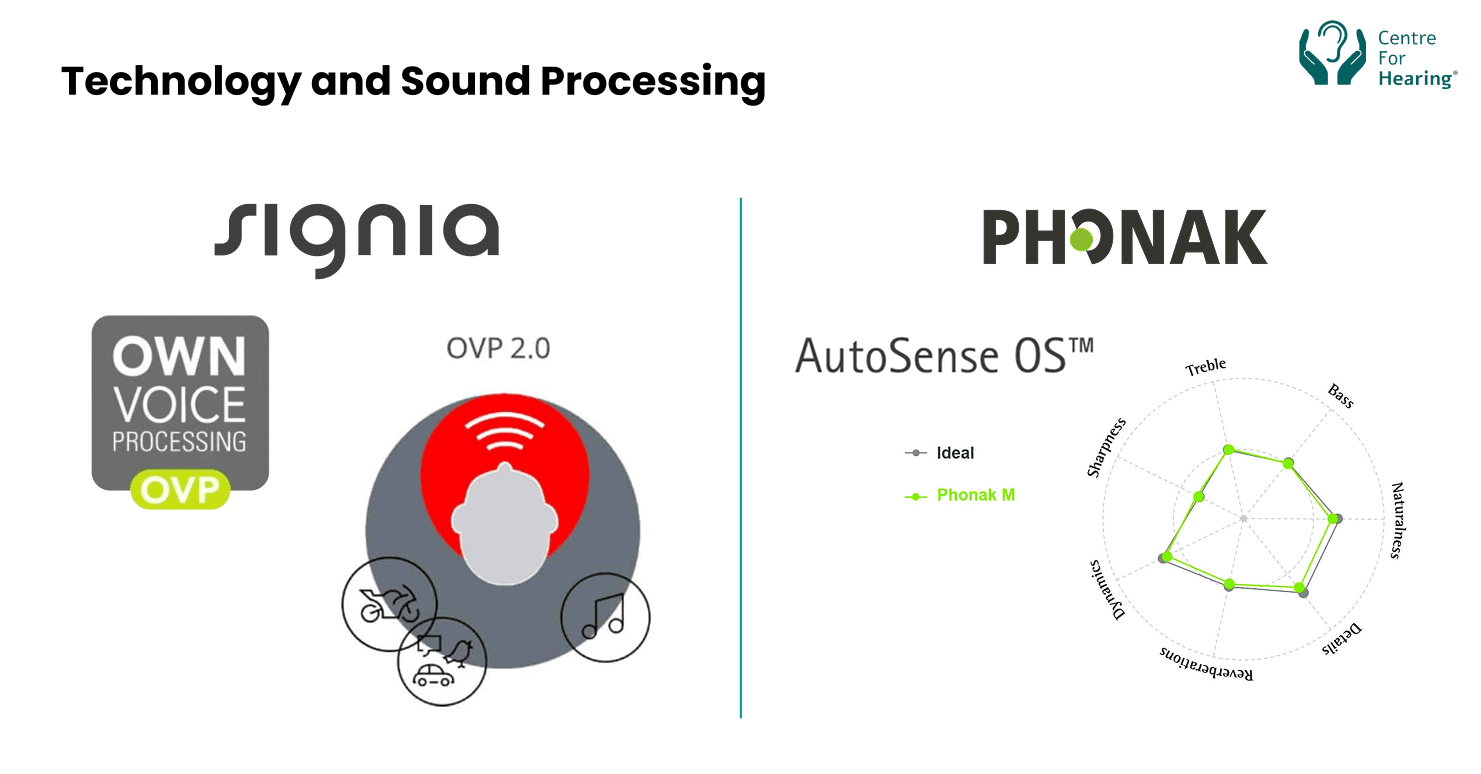
A defining strength of Signia is its Own Voice Processing™ (OVP™) technology, which makes sure your voice sounds natural and distortion-free. This is particularly valuable during phone calls or presentations, as it removes the hollow, ‘inside-the-head’ effect common in many hearing aids.
The brand’s Augmented Xperience™ (AX) platform uses two dedicated processors to separate speech from background noise. Combined with eWindScreen, it makes conversations more comfortable in everyday scenarios, from chatting during morning walks in breezy parks to following discussions at family functions.
Phonak: Adaptive Intelligence with AutoSense OS™
Phonak hearing aids utilise AutoSense OS™, an adaptive operating system that automatically adjusts to different listening environments. Whether in a quiet room or a bustling restaurant, the device detects ambient sounds and fine-tunes itself without needing manual adjustments.
Phonak Infinio Sphere, one of their latest offerings, features new intelligent microphones and advanced motion sensors to track directionality better and improve speech understanding.
2. Design and Durability
Signia: Sleek and Stylish
Signia is known for its excellence in aesthetic design. The Signia Styletto AX is one of the thinnest hearing aids on the market today, designed for wearers who desire a hearing aid that doesn’t compromise on elegance. The Signia Silk X is nearly invisible and snugly fits inside the ear canal, perfect for those looking for discretion.
The overall design language of Signia reflects modern minimalism, catering to younger and style-conscious users.
Phonak: Functional and Flexible
Phonak hearing aids, such as the Phonak Audéo Lumity or Infinio Sphere, emphasise ergonomic comfort and robustness. While they may not be as fashion-forward as Signia, their build is highly durable and well-suited for everyday use, including active lifestyles.
Phonak also provides a variety of form factors, ranging from behind-the-ear (BTE) to receiver-in-canal (RIC) and completely-in-canal (CIC), to suit different degrees of hearing loss and personal preferences.
Shared Climate Resilience:
Both brands carry an IP68 rating, ensuring strong protection against dust, moisture, and sweat for reliable performance in varied climatic conditions.
3. Connectivity and App Integration
Signia: AI-Powered Features
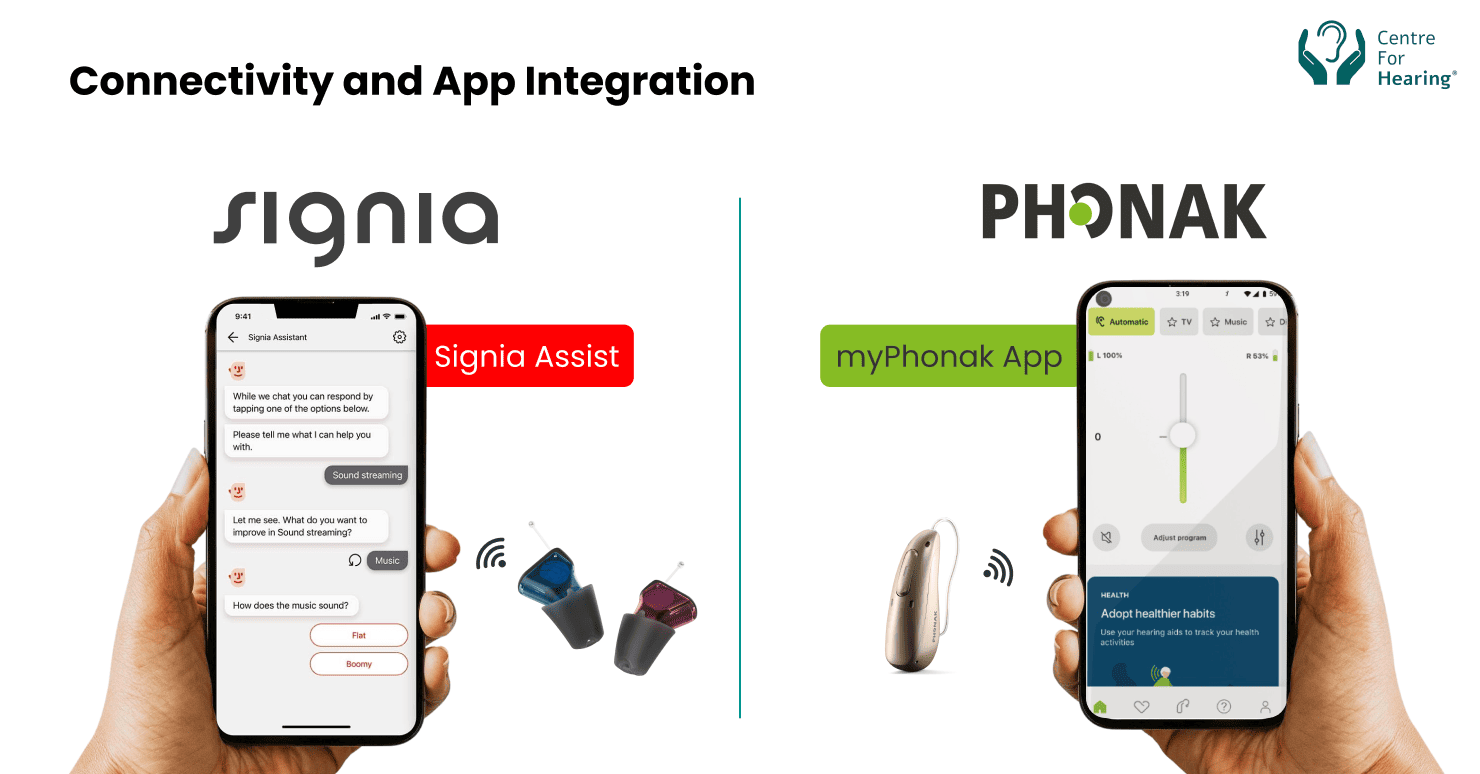
Signia’s App allows full remote control over the device, as well as AI-powered assistance through the Signia Assistant, which acts like a virtual audiologist. It also includes telecare options for remote tuning and counselling with professionals at the Centre for Hearing®.
Signia use Bluetooth LE (Low Energy) with MFi for iOS and ASHA for select Android devices, so you can take WhatsApp calls, listen to Spotify, YouTube, etc., directly through your hearing aids.
Newer phones increasingly support these protocols, but compatibility still depends on the device’s Bluetooth profile.
Phonak: Universal Bluetooth & myPhonak App
Phonak’s devices excel in universal Bluetooth connectivity.
While most brands depend on proprietary protocols, Phonak is the only hearing aid brand that works on standard Bluetooth technology, which means it can connect to nearly any Bluetooth-enabled device, whether Android, iOS or other platforms.
The myPhonak app gives users in-depth control over their hearing aids and health-tracking features (depending on model) such as step count, wear time, etc. It also enables real-time adjustments with the assistance of Centre for Hearing® audiologists.
4. Rechargeability and Battery Life
Both brands feature excellent rechargeable options, but with subtle differences.
- Signia hearing aids, for instance, the Styletto AX, come with pocket-sized portable chargers that can provide up to four days of power without needing to be plugged in. Their Insio line offers rechargeable technology in both ITC and CIC models.
- Phonak offers quick charging, with some models reaching a full day’s use in just 90 minutes of charge. The Audé͏o Sphere Infinio includes a contactless charger and intelligent charging indicators. However, it currently doesn’t have rechargeable technology in ITC or CIC configuration.
If you prioritise portability, Signia’s stylish chargers may be appealing. For fast charging and smart battery management, Phonak leads.
5. Noise Reduction and Speech Clarity
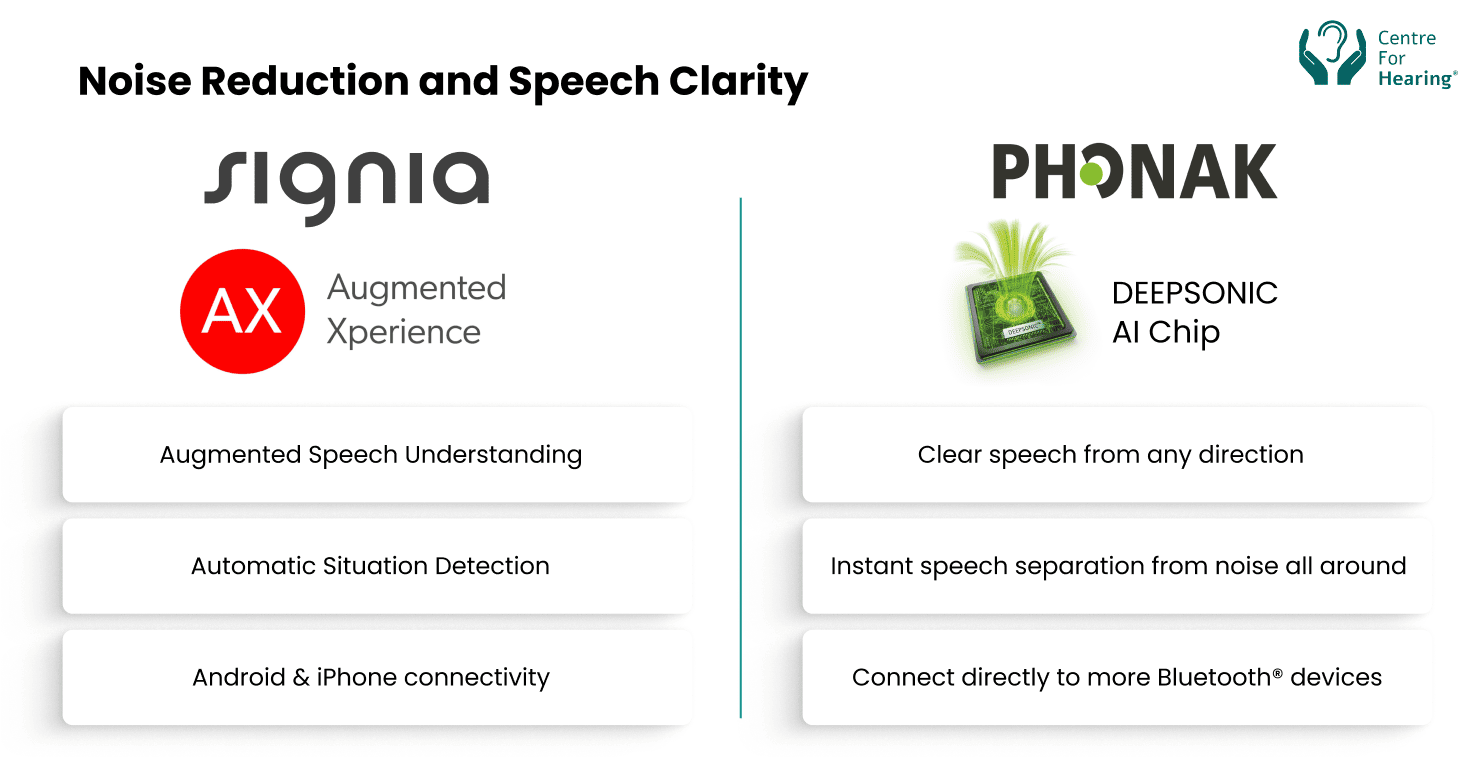
When it comes to performance in noisy environments:
- Signia’s AX platform uses dual processing chips to separate background noise and speech, making it a leader in complex sound environments.
- Phonak’s Speech Enhancer™ algorithm, multi-directional microphones, and the new Infinio Sphere with DEEPSONIC™ AI chip, which applies deep neural network (DNN) processing, give it a strong edge in group conversations and open spaces.
Both brands perform well overall in stand-alone comparisons, but Signia does better in one-on-one conversations in noisy places, while Phonak is stronger in dynamic environments with several speakers.
6. Pediatric Solutions
Phonak: Pediatric-Focused Innovation
Phonak’s Sky range is designed specifically for children. It features a pediatric fitting rationale, LED indicators that allow parents to see if the hearing aids are on, smaller hooks for little ears, tamper-proof battery doors, and compatibility with Roger systems for better classroom listening.
Coming in a range of bright, mix-and-match colours, letting children embrace their personality while wearing them.
Signia: Standard Adaptation
While suitable for children, Signia does not have a dedicated pediatric line. Its Motion BTE models are the same as those for adults, lacking some of the child-focused fit, monitoring features, and colour choices.
7. Tinnitus Features
For those dealing with tinnitus, both brands include the following relief features:
- Signia includes Notch Therapy and various tinnitus masking sounds, integrated into the Signia App.
- Phonak offers the Tinnitus Balance Program, which includes customisable sound therapies and tones.
Both systems are effective, but Signia offers more personalisation via AI, whereas Phonak’s strength lies in simplicity and consistency.
Signia vs. Phonak: A Quick Feature Comparison
Here’s a concise breakdown to help you compare the key features of each brand:
| Feature | Signia | Phonak |
| Sound Quality | Clear, sharp sound quality | Sharp and percussive (auto adjustments) |
| Style & Design | Sleek, modern | Functional, ergonomic |
| Connectivity | Bluetooth, AI-based Assistant via Signia app | Universal Bluetooth plus feature-rich myPhonak app |
| Rechargeability | Portable power banks | Fast charge, smart LED indicators |
| Noise Handling | Best in one-on-one noise | Great in dynamic groups |
| Tinnitus Management | Notch Therapy, personalisation | Reliable masking options |
| Starting Price | ₹20,990 | ₹33,000 |

The Bottom Line
The best hearing aid choice ultimately depends on individual needs and lifestyle preferences.
If prioritising clear speech understanding in noisy environments alongside sleek, stylish designs, Signia may be the ideal fit. On the other hand, if seamless Bluetooth connectivity, durability, and automatic sound adjustments are more important, Phonak could be the preferred option.
Centre for Hearing®: Your Partner in Comprehensive Hearing Care
Even the best hearing aids only reach their full capabilities if they are supported by expert fitting, fine-tuning, and continuous after-care.
That’s where Centre for Hearing® stands apart.
With over 3,00,000+ satisfied customers and trusted since 1973, Centre for Hearing® is India’s leading hearing care provider. Whether you go with Signia or Phonak, our skilled audiologists guide you through each step, from in-depth hearing assessments and real-ear measurements to personalised fittings, post-purchase counselling, including yearly calibrations.
Our clinics across Delhi, Gurgaon, Punjab (Ludhiana, Patiala, Jalandhar), and Chandigarh Tricity Area offer in-person, personalised consultations, ensuring your hearing solution is based on medical expertise, not e-commerce upselling.
Schedule a free consultation today to get expert guidance and try both Signia and Phonak before making your decision.
You can give us a call at +91 9811227269 or email us at care@centreforhearing.com.

FAQs
1. How much will Signia and Phonak hearing aids cost me in India?
The prices range from Rs. 10,990 to Rs. 39,990 for Signia and Rs. 19,000 to Rs. 345,000 for Phonak per device (i.e. per ear).
Centre for Hearing® offers seasonal discounts and insurance options on select models.
2. Can I try hearing aids before buying?
Yes, Centre for Hearing® provides a free consultation and a 2-day trial to help you test hearing aids before making a decision.
3. Which brand is better for noisy, crowded places like busy markets or public areas?
Phonak performs exceptionally well in complex, noisy settings, whereas Signia offers clearer sound during one-on-one conversations with background noise. Pick the option that aligns with your typical environment.
4. Will my smartphone (Android/iPhone) work with these hearing aids?
Both hearing aids are compatible with iOS and many Android models (Samsung, Xiaomi, OnePlus), but compatibility may vary by OS version. Contact Centre for Hearing® audiologists to confirm your phone’s compatibility.
5. How often do I need service and maintenance for hearing aids?
Regular maintenance is important, especially in India’s humid and dusty climate. We recommend scheduling a service visit every 6 to 12 months. Centre for Hearing® offers ongoing support and maintenance plans for your convenience.