

 +91 98112 27269
It’s one of the most common questions we hear. Someone has been advised to wear a hearing aid, feels uncertain about spending a large sum upfront, and wonders whether buying a cheaper one first makes sense as a starting point. A trial run, of sorts. If it works, great. If it doesn’t, not much is lost.
The logic is appealing. It’s the same reasoning people apply to dozens of other purchase decisions. Buy the budget version, see how it goes, and upgrade later if needed.
But hearing aids are not like most other purchases, and that reasoning, while understandable, tends to backfire in ways that aren’t obvious at the outset.
Why Do People Buy a Cheaper Hearing Aid First?
Before getting into what actually goes wrong, it’s worth acknowledging why the impulse exists. Hearing aid prices in India range from ₹12,000 per ear on the entry end to well over ₹4,00,000 for premium AI-enabled devices. That’s a wide range, and sitting somewhere near the top of it feels like a significant financial decision, especially when you’re not sure yet how much of a difference the device will make to your daily life.
There’s also a lack of information. Most people don’t know what distinguishes a ₹25,000 hearing aid (or ear machine, as many people call it) from a ₹1,50,000 one. If the cheaper one produces sound and goes into the ear, why wouldn’t it at least be worth trying first?
These are fair questions. The problem isn’t the reasoning itself. It’s what gets missed when the decision is made without a proper assessment first.
Why a Poorly Fitted Hearing Aid Doesn’t Work

A hearing aid that isn’t correctly matched to your hearing profile doesn’t work the way you’d expect. It might amplify sound, but that alone isn’t the goal. The goal is to restore the specific frequencies you’re actually missing, in proportions your brain can process comfortably, without over-amplifying what you can already hear reasonably well.
This is done through a process called fitting, where an audiologist programmes the device to match your audiogram. Without this step, a hearing aid is essentially guesswork. Even a well-made device at a mid-range price point will underperform if it’s been set up based on assumptions rather than your actual test results.
Cheaper hearing aids bought online or over the counter are almost never fitted this way. They’re set to amplify across a broad range and left at that. For some people with very mild, broadly distributed hearing loss, this might produce a passable result. For most people, it means an experience that ranges from mildly unsatisfying to actively unpleasant.
When Is an Entry-Level Hearing Aid the Right Choice?
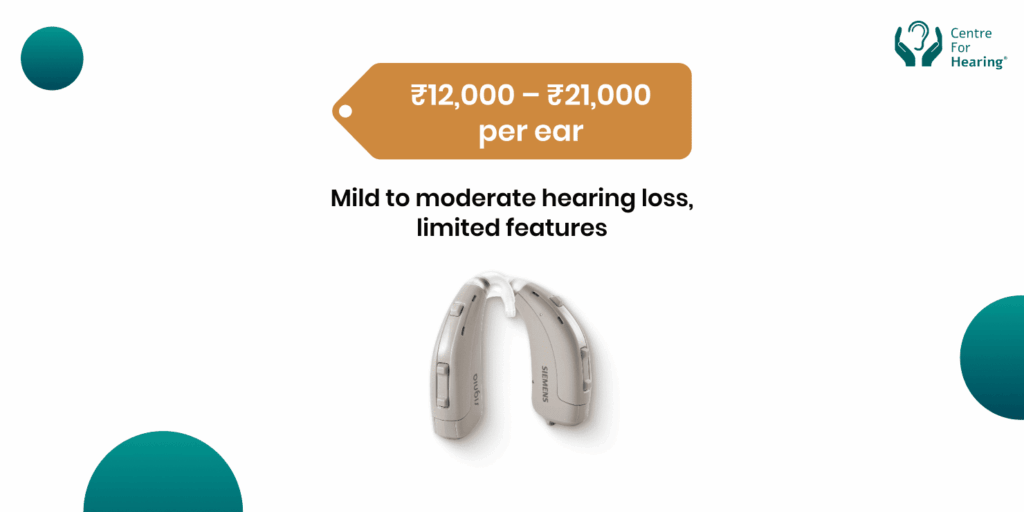
None of this means that an entry-level or basic digital hearing aid is never appropriate. It absolutely can be, for the right person.
At Centre for Hearing®, our pricing structure has entry-level options starting from ₹12,000, and basic digital models from ₹21,000 upwards. Across these tiers, we stock devices from internationally recognised brands including Phonak, Signia, Widex, ReSound, and Oticon, so the recommendation is always based on fit, not brand availability. These are battery-operated devices suited for people who spend most of their time in quiet environments at home and don’t need the noise management or directionality features that more active lifestyles demand.
If someone has mild hearing loss, lives a relatively quiet day-to-day life, and has been assessed by an RCI-certified audiologist who recommends this tier, then starting here is entirely sensible. The issue isn’t the price. The issue is whether the decision was made based on a proper assessment or based on budget anxiety alone.
A cheaper hearing aid recommended after a thorough hearing test is a thoughtful choice. The same device purchased without one is a gamble.
Which Hearing Aid Tier Suits Your Lifestyle?
It helps to understand concretely what distinguishes price points, rather than thinking about it in abstract terms.
1. Entry-Level and Basic Digital (₹12,000–₹40,000)
These devices are built for one-to-one conversations in close range, in quiet settings. Think: at home, in a calm room, a quiet face-to-face exchange. They run on disposable batteries, have limited programmability, and don’t include noise cancellation or Bluetooth connectivity. They work well when an audiologist has confirmed this tier matches the person’s hearing profile.
2. Essential Class (₹45,000–₹80,000)
For people who regularly navigate small groups of two to three people in mildly noisy surroundings. A family dinner, a small social gathering, and running everyday errands. You get rechargeable batteries and Bluetooth connectivity, which makes a real difference for slightly active lifestyles where convenience matters.
3. Mid-Level / Standard Class (₹85,000–₹1,50,000)
This tier suits more active routines: groups of three to six people, small meetings at work, social gatherings, and environments with moderate background noise. Active noise cancellation, directional microphone control, and motion sensors that adjust the device as you move between environments are standard here. An entry-level device in those situations isn’t a slightly worse version of a mid-range one. It’s a functionally different experience.
4. Advanced Class (₹1,50,000–₹2,50,000)
AI-enabled technology, with devices that learn your listening preferences and adapt automatically. Built for people who are active both socially and professionally: larger group conversations, conference rooms, small events, and settings where speech in background noise needs to be separated out clearly.
5. Premium Class (₹2,75,000–₹4,50,000)
No compromise. For people with demanding professional and social lives, this tier handles the full range: boardroom meetings, parties, crowded restaurants, and large events. These devices adapt in real time and are built for those who can’t afford to miss a word in any setting.
Not sure which tier suits your situation?
Our free first consultation includes a full hearing assessment by an RCI-certified audiologist, after which we’ll give you a clear recommendation based on your actual hearing profile and lifestyle.
No pressure, no sales pitch. Call us on +91 9811 227 269 or book online.
The True Cost of Buying the Wrong Hearing Aid
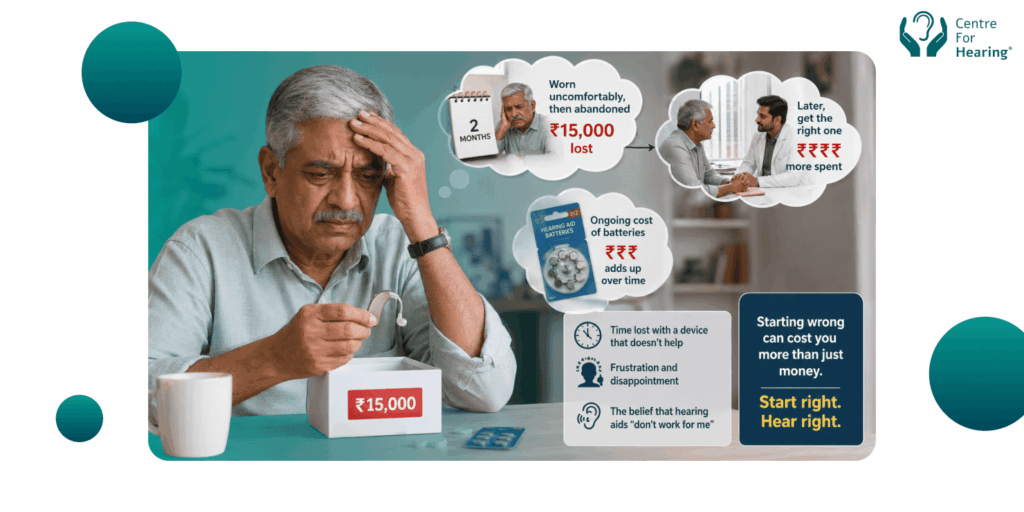
One thing that rarely gets factored into the “start cheap” calculation is the total cost of getting it wrong. If someone buys a ₹15,000 hearing aid without professional guidance, wears it uncomfortably for two months, and eventually abandons it, they’ve lost that money entirely. Then, if they eventually come in for a proper consultation and end up with the device that actually suits them, they’ve now spent considerably more than if they’d started right.
There’s also the ongoing cost of batteries for non-rechargeable devices, which adds up more than most people expect over a year or two.
And beyond money: the time spent wearing a device that doesn’t help, the frustration, the reinforced belief that hearing aids “don’t work for me.” These aren’t trivial.
How to Choose a Hearing Aid Without Overspending
The real question isn’t “should I buy a cheaper hearing aid first?” It’s “how do I make a confident, informed decision without over-committing financially before I understand what I need?”
That’s a much better question, and it has a better answer.
At Centre for Hearing®, our first consultation is free. We conduct a comprehensive hearing assessment using European diagnostic equipment, handled by our RCI-certified audiologists, to determine the nature and degree of your hearing loss. Based on that, we’ll recommend a device category that actually suits your situation.
And before you spend anything, we offer a free hearing aid trial. You can experience how the recommended device performs in your actual environment before making a purchase. That removes the need to guess or hedge. You’re not buying on hope; you’re buying on experience.
We also offer a home visit facility for those who can’t easily come to a clinic. Our audiologist visits you, conducts the assessment, and helps you understand your options at home.
How to Get Started with a Hearing Aid in India
With over 50 years of experience in hearing care, and more than 3,00,000 satisfied customers across our clinics in Delhi NCR, Gurugram, Chandigarh, Ludhiana, Patiala, and Jalandhar, we’ve helped a great many people navigate this exact decision.
If you’re uncertain about where to start, the free consultation and trial take the guesswork out entirely. You’ll leave knowing what you need and why, which is a better position than any cheaper device on its own could put you in. Book your free consultation today
If you’d like a quick first check from home, you can also take our free 3-minute online hearing screener before your visit.
Frequently Asked Questions
1. Can a cheaper hearing aid damage my hearing?
Not in the way that loud noise does, but a poorly fitted device that over-amplifies certain frequencies can cause discomfort and listening fatigue over time. More commonly, the issue is underperformance rather than harm: the device doesn’t do enough, and the person stops wearing it altogether.
2. What is the minimum budget for a good hearing aid in India?
This depends entirely on your hearing profile and lifestyle. Entry-level digital hearing aids at Centre for Hearing® start from ₹12,000 per ear and are appropriate for mild hearing loss in quiet home environments. For someone with a more active routine, the Essential Class (starting from ₹45,000) or Mid-Level / Standard Class (from ₹85,000) will serve you considerably better, depending on how active your lifestyle is. The number that matters is the one an audiologist recommends after your assessment, not the lowest figure you’ve seen advertised.
3. Are cheap hearing aids available online worth trying?
Online hearing aids are not something we recommend. They’re sold without a hearing test, without professional fitting, and without any aftercare support. Even if the device itself is functional, the absence of proper programming means it won’t be matched to your actual hearing loss. The result is almost always disappointing, and in many cases puts people off hearing aids altogether for years.
4. Can I trial a hearing aid before buying?
Yes. At Centre for Hearing®, we offer a free hearing aid trial so you can experience how a recommended device performs in your daily environment before committing. This is the most reliable way to make a confident purchase decision without financial risk.