

 +91 98112 27269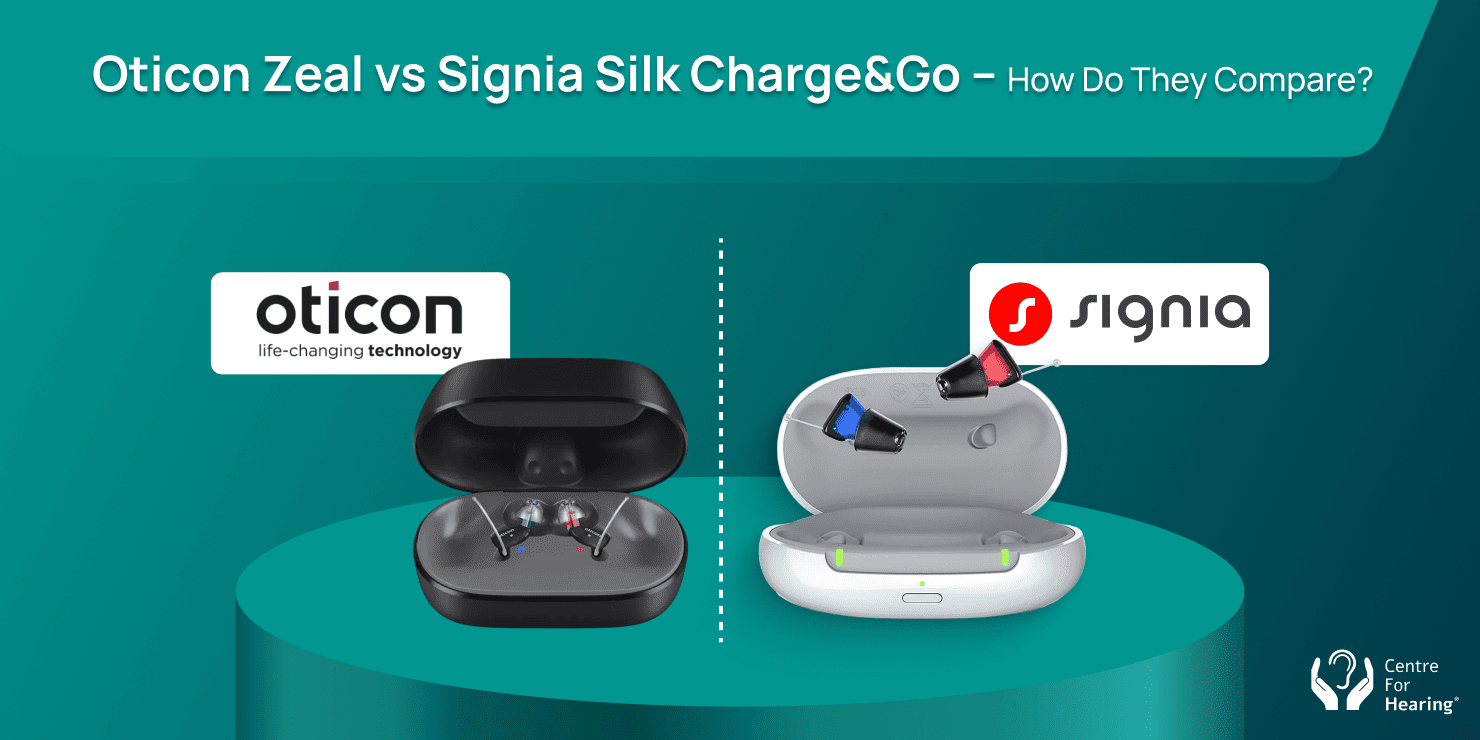
The Oticon Zeal and the Signia Silk Charge&Go both sit almost entirely inside the ear canal, so if you’ve narrowed your search down to these, you’ve already ruled out the behind-the-ear or RIC styles. Both are rechargeable hearing aids that sit almost entirely inside the ear canal, both charge overnight instead of taking disposable batteries, and both promise a same-day fit without a custom mould. Where they pull apart is connectivity, and that one difference changes who each device suits.
Key Takeaways
- Oticon Zeal streams calls and audio over Bluetooth LE Audio and Auracast. Signia Silk Charge&Go doesn’t stream.Signia Silk Charge&Go comes in five technology tiers (entry level 1IX, 2IX, 3IX, 5IX, to-end 7IX), so the feature set can flex with budget. Zeal ships as one configuration, at one price point.
- Both are rated for mild to moderate hearing loss, roughly up to 75dB, and both carry an IP68 rating against sweat, rain and dust.
- Neither is the right pick for severe or profound hearing loss. Ask about Centre for Hearing®’s RIC or BTE ranges instead.
What Kind of Hearing Aid Are You Actually Choosing Between?
Both of these sit in the completely-in-canal category, the style that’s genuinely hard to spot even when someone’s looking directly into your ear. That’s a different conversation from Bluetooth hearing aid models built as receiver-in-canal devices, which sit partly behind the ear and are what most people picture when they think ‘hearing aid.’
Oticon Zeal
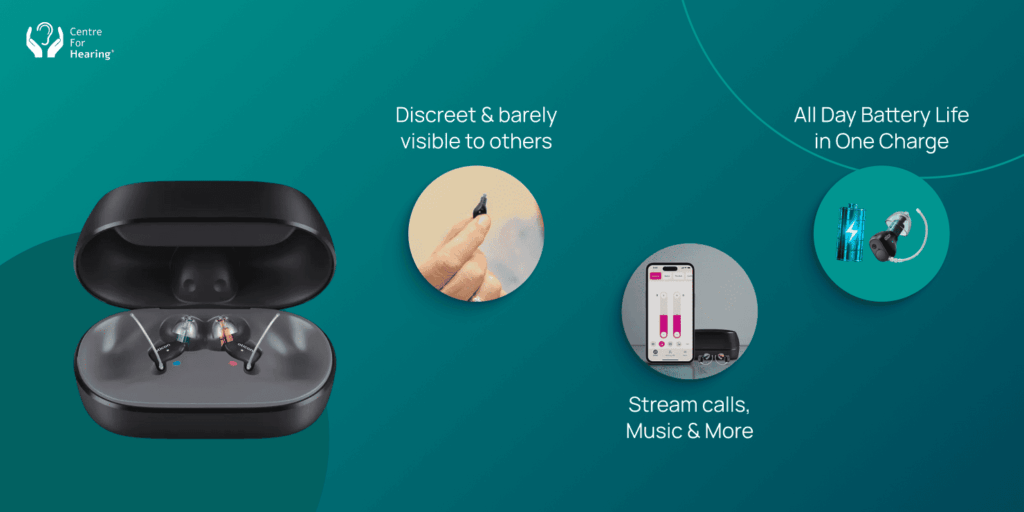
Oticon launched Zeal in early 2026 as its first device in a new ‘in-the-ear’ line, built around a single-piece encapsulation instead of the usual shell-and-battery-door construction. That’s partly why it can carry an IP68 rating in such a small housing. It runs the same core chip and processing as Oticon’s flagship Intent line, so you’re not getting a scaled-down version of the technology just because the device is smaller. It fits same-day using soft domes, with a custom silicone or acrylic mould available if the ear canal needs it.
Signia Silk Charge&Go
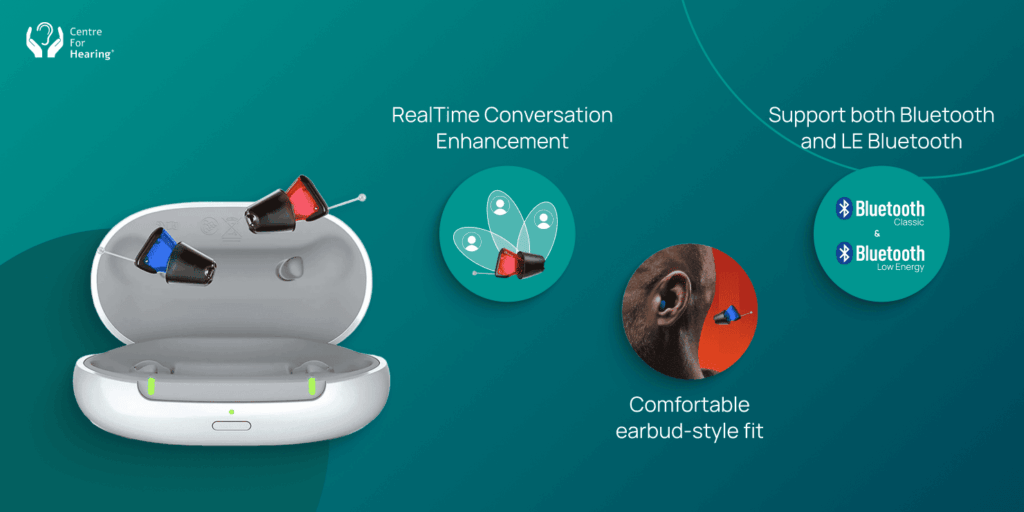
Signia’s Silk range has been around longer, but the Charge&Go IX version is the first to add a rechargeable battery to that ultra-small form factor. It uses “click sleeves,” soft silicone tips in several sizes, rather than domes, and a custom mould is available too. It’s built on Signia’s IX platform, which splits speech and background noise into separate processing paths inside one chip. The pocket charging case doubles as a small power bank, good for a few extra charges when you’re away from a plug point.
Where Do Oticon Zeal and Signia Silk Charge&Go Differ Most?
This is the part worth reading slowly, because the differences run in both directions.
Zeal offers connectivity of your hearing aids with the mobile phone! It connects over Bluetooth LE Audio and supports Auracast, so phone calls, music, and audio from compatible public systems (an airport announcement, a TV with Auracast broadcast) go straight into the device. Silk Charge&Go doesn’t do this.
Silk Charge&Go, in turn, covers ground Zeal doesn’t. It’s the only one of the two with a CROS/BiCROS configuration, which matters if you have significant hearing loss in one ear and near-normal hearing in the other. It’s also the only one offered across five technology tiers, so you’re choosing a feature level and a price point, not just a device. Zeal comes in a single high-end-only configuration, which is simpler to decide on but leaves no room to scale up or down later.
Own Voice comfort is worth weighing honestly for both. Signia markets Own Voice Processing on the Silk Charge&Go to reduce the boomy sound of your own voice, and independent lab testing on the device scored that feature poorly in practice. Oticon doesn’t make the same specific claim for Zeal, but it’s the kind of thing that varies person to person regardless of brand. Worth trying both in a real fitting rather than deciding from either brand’s marketing copy.
Oticon Zeal vs Signia Silk Charge&Go: Key Differences at a Glance
| Feature | Oticon Zeal | Signia Silk Charge&Go |
| Style | Instant-fit CIC, custom mould optional | Instant-fit CIC (click sleeves), custom mould optional |
| Bluetooth streaming | Yes (LE Audio + Auracast) | No |
| Hearing loss range | Up to ~75dB (mild to moderate) | Up to 80dB (mild to moderate) |
| Battery | Rechargeable, up to 20 hours | Rechargeable, up to 28 hours |
| Water/dust rating | IP68 | IP68 |
| Technology tiers | Single configuration | Five tiers (1IX, 2IX, 3IX, 5IX, 7IX) |
| Colour options | Black | Mocha, Black |
| Special use case | Same processing chip as Oticon’s flagship line | CROS/BiCROS option for single-sided hearing loss |
Neither one solves severe hearing loss. If that’s your situation, the Centre for Hearing®’s RIC hearing aid range or BTE hearing aid range will fit better than either device covered here. Both Zeal and Silk Charge&Go are genuinely tiny, and inserting or removing a device that small takes some practice either way.
Not sure which of these actually fits your hearing loss and lifestyle?
Book a free consultation at Centre for Hearing® and try both before deciding, or call +91 9811 227 269.
Who Should Pick the Oticon Zeal, and Who Should Pick the Silk Charge&Go?
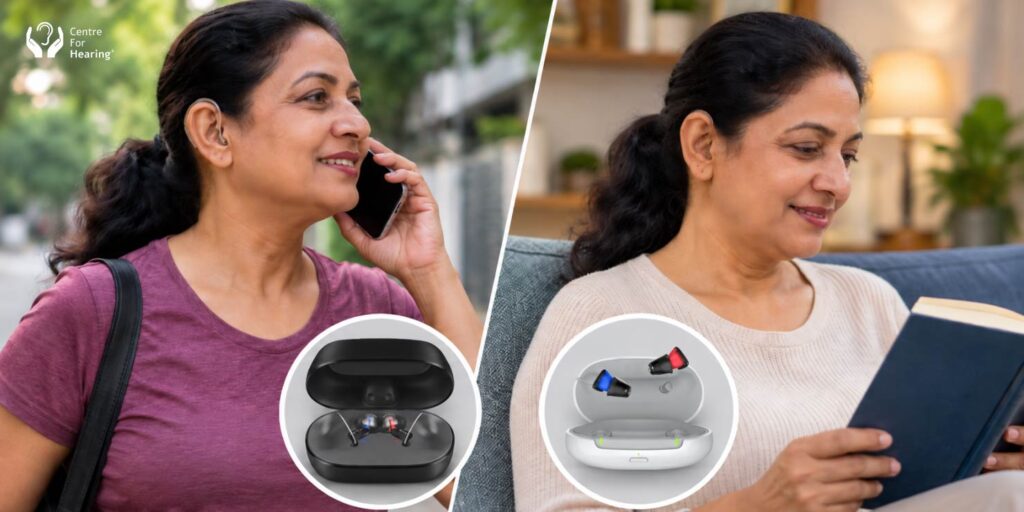
If you’re on your phone throughout the day, take calls on the move, or already stream music through wireless earbuds, Zeal closes a gap that older in-canal devices couldn’t. You keep the discreet size and get the connected features that used to mean choosing a bigger device.
Silk Charge&Go makes more sense if streaming isn’t a priority for you, and you’d rather have room to move between five technology tiers depending on budget. The CROS/BiCROS option is also worth knowing about if you have significant hearing loss in one ear and near-normal hearing in the other. This is a specific enough need that it can rule out Zeal on its own, since Zeal doesn’t currently offer this configuration.
Fit is where a lot of people get surprised. Both devices sit deep in the canal, and comfort depends more on the shape of your ear canal than on the brand. This is genuinely something to test in person, not decide from a brochure.
The invisible hearing aid guide covers what a fitting appointment for this style involves, if you want to know before you walk in.
What Does Pricing Look Like for These Two Hearing Aids?
For the Silk Charge&Go IX, Signia’s retail price list (effective March 2026) lists the 1IX at ₹1,39,990 per pair, rising through the 2IX, 3IX and 5IX to ₹7,24,990 for the top 7IX tier.
Oticon Zeal is expected to cost ₹ 4.25 lacs- 4.75 lacs per ear.
For an accurate figure, check Centre for Hearing®’s current price list or speak to a clinic directly. Where a package includes a trial period, warranty terms, or aftercare visits, ask what’s covered before comparing two numbers side by side.
Contact your nearest Centre for Hearing® clinic to check current availability and pricing for the Oticon Zeal specifically.
Silk Charge&Go IX Price
| Tier | MRP (₹) |
| 7IX | 7,24,990 |
| 5IX | 4,33,990 |
| 3IX | 3,14,990 |
| 2IX | 1,99,990 |
| 1IX | 1,39,990 |
Silk Charge&Go CROS/BiCROS IX Price
| Tier | MRP (₹) |
| CROS 7IX | 4,12,990 |
| CROS 5IX | 2,66,990 |
| CROS 3IX | 2,07,990 |
| CROS 2IX | 1,49,990 |
| CROS 1IX | 1,19,990 |
Still weighing between Oticon Zeal and Signia Silk Charge&Go?
Book a Hearing Aid Demo at your nearest Centre for Hearing® clinic, or call +91 9811 227 269 to speak with an audiologist first.
Frequently Asked Questions
1. Does the Oticon Zeal work with Android phones the same way it works with iPhone?
The Zeal is primarily built for iPhone and can pair with certain latest Android models using the ASHA protocol and supporting Bluetooth LE Audio. Worth checking your specific phone model before assuming full functionality.
2. Can the Signia Silk Charge&Go be used by someone with single-sided hearing loss?
Yes. It’s available in a CROS/BiCROS configuration for exactly this, where the device on the poorer ear picks up sound and routes it to the better ear. Zeal doesn’t currently offer this setup.
3. Is the Oticon Zeal available with a custom ear mould, or only the standard dome fit?
Both. It fits same-day with rubber domes, and a custom silicone or acrylic mould is available if your ear canal needs it.
4. Why does the Signia Silk Charge&Go not support Bluetooth streaming when other Signia models do?
Its size is the constraint. Fitting a Bluetooth streaming radio into a shell this small, while also fitting a rechargeable battery, is a tighter engineering trade-off than in Signia’s larger RIC or BTE models, which is where those Bluetooth features currently live instead.
5. Does the Oticon Zeal’s antenna design affect how visible it is in the ear?
Slightly, depending on ear shape. The antenna doubles as the removal string and retention filament, and for most people it’s barely noticeable, but it can be more visible in some ear canals than others.
6. Can I upgrade a Signia Silk Charge&Go 3IX to a higher tier later, or is that fixed at purchase?
Fixed at purchase. The 1IX, 2IX, 3IX, 5IX and 7IX tiers are different hardware, not a software unlock, so moving up a tier means a new device.
7. Are the Oticon Zeal and Signia Silk Charge&Go rated for the same degree of hearing loss?
Yes, both are designed for mild to moderate hearing loss, roughly up to 75dB. Neither is intended for severe or profound loss.
8. Does either device support hands-free calling without holding the phone to your ear?
Zeal does, over Bluetooth LE Audio. Silk Charge&Go doesn’t stream calls, so hands-free calling isn’t available on that device.