

 +91 98112 27269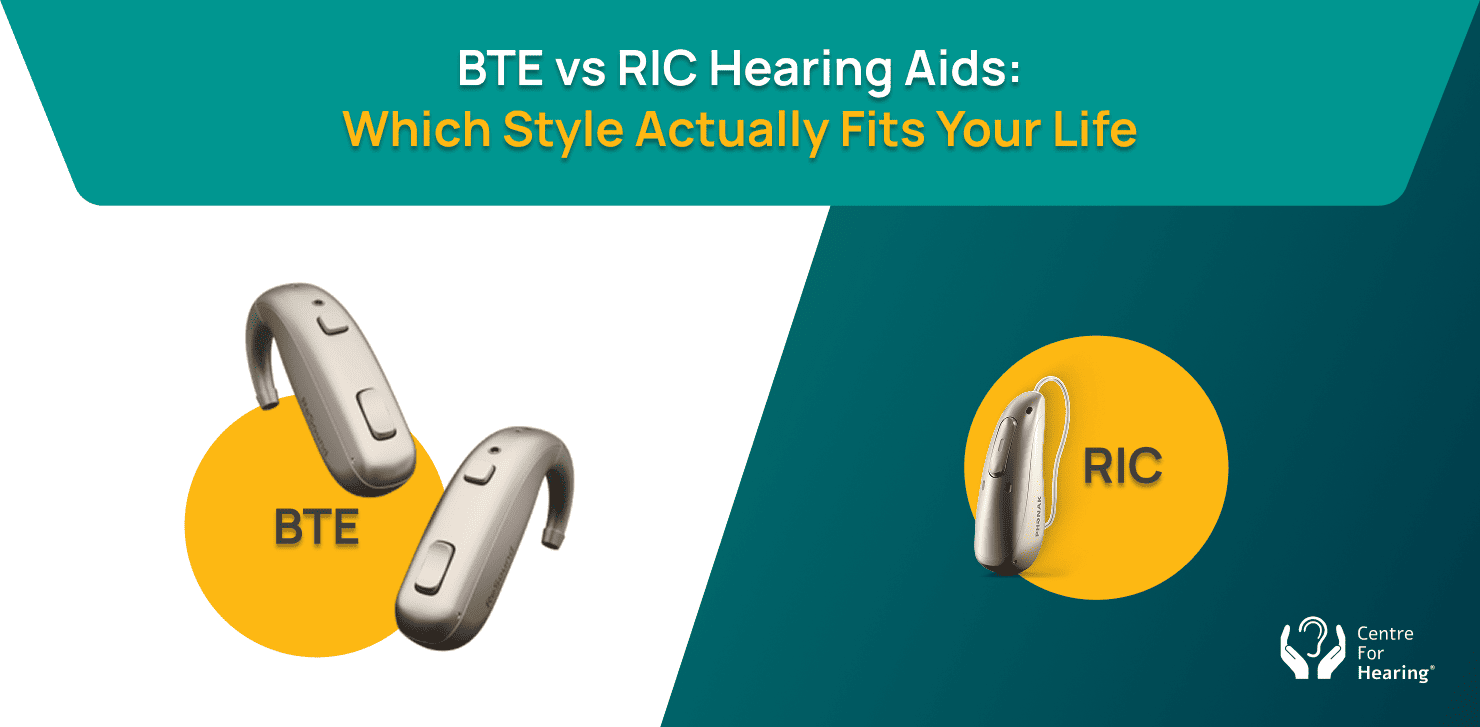
Ask ten people what the “best” hearing aid style is, and you’ll probably get ten different opinions, most of them based on what a relative or neighbour happens to wear. That’s not a great way to choose. Two styles come up in nearly every audiologist’s recommendation: the Behind-the-Ear (BTE) hearing aid and the Receiver-in-Canal (RIC) hearing aid. Both sit behind the ear. Both cover a wide range of hearing loss. But how they fit into your actual week, whether that’s twelve-hour shifts on your feet, back-to-back video calls, or looking after grandchildren, tends to differ more than most comparison charts let on.
This isn’t a guide to ear anatomy. It’s a look at how BTE and RIC hearing aids behave once you leave the clinic and get on with your day.
Key Takeaways
- BTE hearing aids suit severe to profound hearing loss and are easier to handle for users with dexterity issues.
- RIC hearing aids are smaller, more discreet, and now handle mild to severe hearing loss well with a power receiver.
- BTE prices in India start around ₹19,490, and RIC prices start around ₹25,990, both varying by brand and features.
- Dexterity, moisture exposure, and visibility matter more day to day than the “stronger” style on paper.
- A hands-on hearing test and demo is the only reliable way to choose between the two, not a spec comparison.
What’s Actually Different Between a BTE and a RIC Hearing Aid?
A BTE keeps its whole works (the microphone, amplifier, and speaker) in a case that sits behind the ear, connected to the ear canal by a tube and an earmould. A RIC splits the job differently: the case behind the ear holds the microphone and processor, while the speaker, called the receiver, sits inside the canal itself, linked by a thin wire.
That one design choice explains most of what people notice day to day.
| Feature | BTE | RIC |
| Size and visibility | Larger case, more visible | Smaller case, thin wire is far less noticeable |
| Sound quality | Strong, dependable amplification | More natural sound, less “talking in a barrel” feel |
| Best suited for | Severe to profound hearing loss | Mild to severe hearing loss |
| Handling | Bigger buttons and battery door | Smaller components, more fiddly for some users |
| Starting price in India | Around ₹19,490 | Around ₹25,990 |
If Your Hearing Loss Is Severe, Does That Decide It for You?
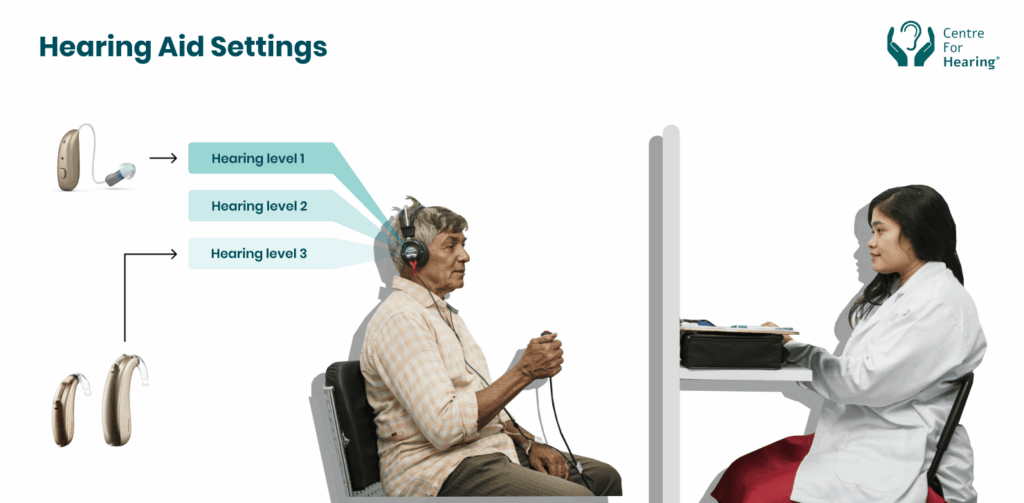
To some extent, yes. BTE hearing aids, especially super power BTE models, deliver more amplification, which is why they remain the standard recommendation for severe to profound hearing loss and for ears where a receiver can’t sit comfortably in the canal. Children are frequently fitted with BTE devices too, since the earmould can be resized as the ear grows, without replacing the whole hearing aid.
RIC devices cover more ground than they once did. Several current models handle severe hearing loss comfortably with a power receiver, not just mild to moderate cases. If your audiogram shows severe loss, it’s worth asking whether a power RIC could work before assuming BTE is your only route.
If you’re not sure how severe your hearing loss actually is, that’s not something to guess at from home.
Book a Free Consultation and get a proper hearing test before choosing a style based on how the loss “feels” day to day.
If You’re Worried People Will Notice, Which One Hides Better?
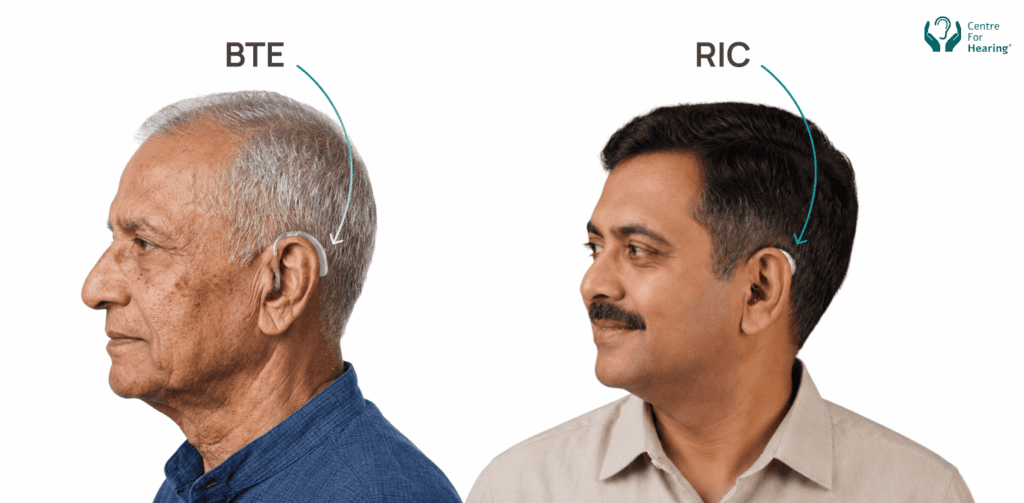
For a lot of first-time users, this matters more than any spec sheet. The RIC’s smaller case and slim wire sit closer to the head and are harder to spot than a BTE’s fuller case and tubing. It’s a big reason RIC has become the most recommended style at hearing clinics in India today, particularly among brands like Phonak, Signia, Oticon, and Widex that pair the smaller size with strong sound processing.
That said, ask yourself honestly who’s actually looking that closely. Most colleagues and family members aren’t scrutinising your ears. If discretion is the only thing holding you back, fully custom in-canal styles exist too, and your audiologist can walk you through whether one suits your hearing loss.
Which Style Is Easier to Handle Day to Day?
This deserves real weight, especially for older users or a family member buying on someone’s behalf. A hearing aid that’s hard to insert, adjust, or clean tends to end up sitting unused in a drawer. Research on older adults who stop wearing their hearing aids repeatedly points to device handling as a practical reason for that drop-off, alongside comfort and perceived benefit, and a separate review on ageing and hearing aid handling found first-time users past 75 tend to struggle more with smaller, in-canal components than with larger BTE cases.
BTE devices tend to be the more forgiving option here. The bigger case, larger battery door, and sturdier tubing are easier to manage for someone with arthritis or a mild tremor. RIC devices are lighter and just as manageable once someone’s used to them, but the receiver wire is thinner and needs more careful handling during cleaning.
If dexterity is a genuine daily struggle, rechargeable versions of either style remove the battery-handling problem entirely, and that switch is often the bigger win over choosing BTE purely for its size.
If handling feels like the deciding factor for you or a parent, Call Us Now at +91 9811 227 269 and our audiologists can talk you through which specific models are easiest to manage.
Do You Sweat, Exercise, or Spend Your Day Outdoors?

Sweat and humidity, especially through the monsoon months, are hard on any electronic device, but the RIC’s receiver sits closer to where moisture collects in the ear canal. If you’re at the gym daily or on the road for long outdoor shifts, ask specifically about moisture-resistant coatings, or consider whether a BTE’s sturdier build suits your routine better. Both styles can be protected with dehumidifier kits and regular servicing, so this isn’t a dealbreaker either way. It’s just worth flagging with your audiologist upfront rather than discovering it the hard way.
What About Bluetooth, Phone Calls, and Streaming to Your TV?
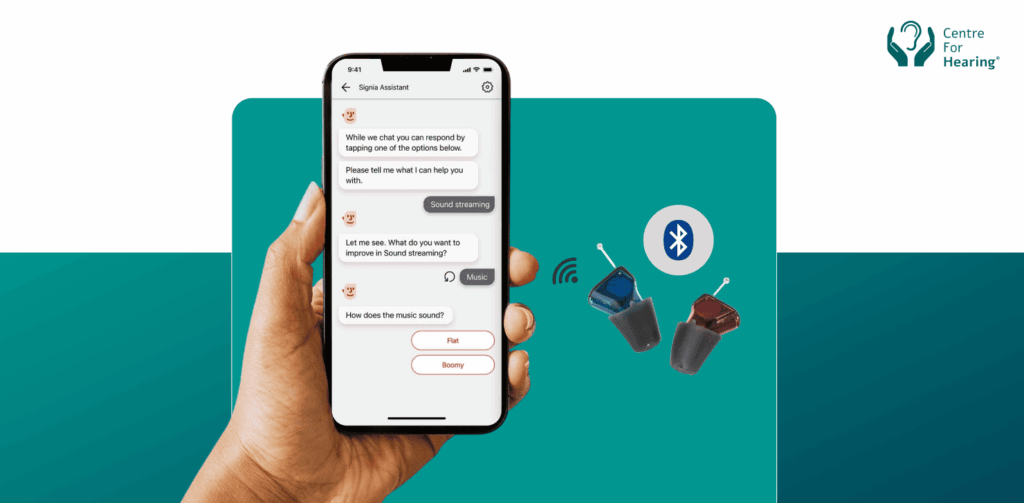
Most current BTE and RIC models, including several from Signia and Phonak, come with Bluetooth streaming for calls, music, and TV audio as standard from the mid-range tier upward. The difference here isn’t really the style, it’s the price tier. Entry-level devices in either category are less likely to include streaming, so if this feature matters to you, it deserves more of your attention than the BTE-versus-RIC question does.
What Do BTE and RIC Hearing Aids Cost in India?
| Type | Starting Price | Typical Range |
| BTE (standard, rechargeable, Bluetooth) | ₹19,490 | Up to ₹4,32,000 |
| Super Power BTE | ₹48,500 | Up to ₹3,49,995 |
| RIC | ₹25,990 | Up to ₹3,80,000 |
Exact pricing depends on the brand, the technology tier, and whether you need rechargeable or Bluetooth features, so it’s worth getting a written quote after your hearing test rather than going by an online range alone. You can see a fuller breakdown on our hearing aid prices page.
If you’d like a clearer estimate for your specific hearing loss, Book a Free Consultation with one of our audiologists. We’ll walk you through actual options and pricing rather than a general range.
So Which One Actually Fits Your Life?
- If your hearing loss is severe or profound, a BTE, especially a super power model, is usually the safer starting point.
- If you want the most discreet option for mild to severe loss, RIC tends to be the better fit.
- If dexterity is a genuine daily struggle, lean towards a rechargeable BTE, or ask about app-based volume control on either style.
- If you’re outdoors and sweating for hours most days, ask specifically about moisture protection whichever style you pick.
- If none of these apply strongly, sound quality and comfort during a hands-on trial should decide it, not a diagram in a brochure.
At Centre for Hearing®, our Experienced M.Sc. Audiologists fit you with both styles during your hearing aid demo, so you hear the difference yourself before deciding.
Book a Hearing Aid Demo at your nearest clinic across Delhi NCR, Gurugram, Noida, Chandigarh, Ludhiana, Patiala, and Jalandhar, or Call Us Now at +91 9811 227 269 for a straight answer on your specific case.
Frequently Asked Questions
1. Can I Switch From a BTE to a RIC Hearing Aid Later?
Switching styles means a new device rather than an adjustment to your existing one, so it’s worth raising with your audiologist during a routine check if your hearing loss or daily routine has changed enough to justify the move.
2. Which Lasts Longer, a BTE or a RIC Hearing Aid?
BTE hearing aids generally have a slight edge, since there’s no receiver wire to wear out. Both styles typically last four to six years with proper servicing, though a RIC’s receiver may need replacing once or twice within that span.
3. Is a RIC Hearing Aid Strong Enough for Severe Hearing Loss?
Many current RIC models handle severe hearing loss well with a power or an ultra-power receiver; but profound loss usually still calls for a BTE or super power BTE. Your audiogram should decide this, not the style name.
4. Do BTE Hearing Aids Look Bulky?
Modern BTE cases are considerably smaller than models from even five years ago, and slim-tube versions reduce visibility further. They’re still larger than a RIC case, but “bulky” is less accurate than it used to be.
5. Which Style Is Better for Children?
BTE is the more common recommendation for children up till the age of 12-15 years, since the earmould can be resized as the ear grows without replacing the entire ear machine. The ear canal has usually fully grown by the mid-teens.