
 +91 98112 27269
You’ve probably come across them while scrolling. A two-minute quiz promising to tell you whether you have hearing loss. Or a quick audio tone test you take right on your phone. Online hearing tests are everywhere now, and a surprising number of people take them every day.
But do they actually work? And more importantly, can you rely on the result?
The short answer is: sort of. Online hearing tests can be a useful first step, and a well-designed screener is worth taking. But they’re screening tools, not diagnostic ones, and there’s a meaningful difference between the two. Here’s what you need to know before you take one, and what to do with the result once you have it.
What an Online Hearing Test Actually Does
Most online hearing tests work in one of two ways. The first type plays a series of audio tones at different frequencies and volumes and asks you to indicate whether you can hear them. The second is a questionnaire that asks about your listening habits: do you ask people to repeat themselves, do you struggle with phone conversations, does background noise bother you more than it used to?
Both formats serve the same basic purpose: to flag whether your hearing might warrant professional attention. That’s it. They’re designed to raise a flag, not lower a verdict.
The tone-based ones come closer to an actual hearing test, since they’re testing your ability to detect sound at specific frequencies. But even these have significant limitations that we’ll get into below.
Also Read: How Often Should You Get a Hearing Test? Age-Wise Breakdown
Where Online Hearing Tests Fall Short
This is the part that matters most, and it’s worth understanding in some detail.
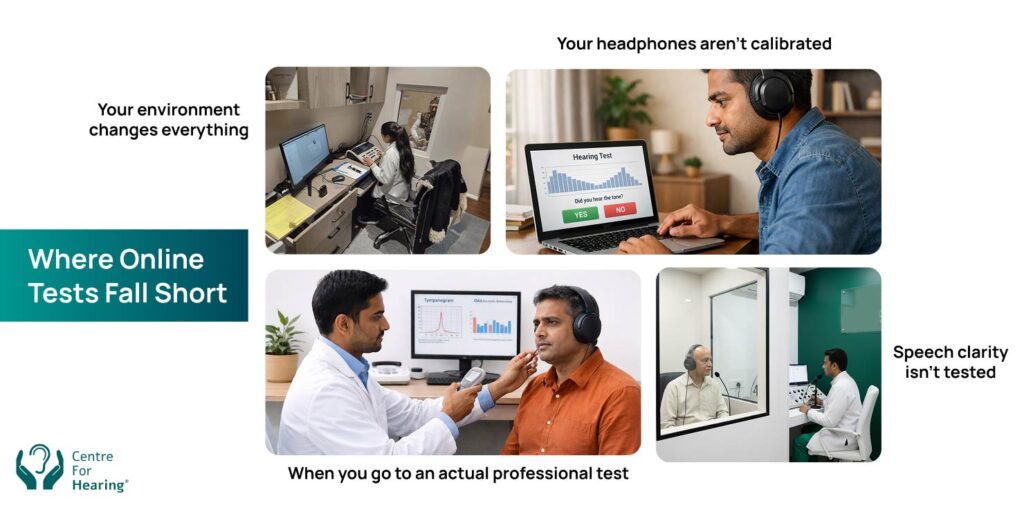
Your Environment Changes Everything
A clinical hearing test happens inside a soundproof booth, using calibrated equipment. An online test happens wherever you are right now. That might be a quiet bedroom, or it might be a room with a fan, traffic noise, or a television in the background. If you miss a tone because of ambient noise, the result is meaningless.
Your Headphones Aren’t Calibrated
The earphones or speakers you use at home have not been calibrated for audiometric testing. Volume output varies significantly between devices, which means the test doesn’t know whether a tone was played at 40 decibels or 55 decibels in your ear. Without that precision, the frequency thresholds the test produces can’t be trusted.
They Can’t Tell You Why
Even if an online test correctly identifies that you’re struggling to hear certain frequencies, it tells you nothing about the cause. Hearing loss that originates in the outer or middle ear responds very differently to treatment than hearing loss originating in the inner ear or auditory nerve. A proper evaluation includes tests like Tympanometry and Oto-Acoustic Emissions to identify where the problem lies.
Speech Clarity Isn’t Tested
Many people with hearing difficulty can detect tones reasonably well but struggle to understand speech, particularly in noisy environments. Online tests almost never measure this. Speech discrimination is one of the most important indicators for hearing aid selection, and it requires a speech audiometry test conducted in a clinical setting.
These aren’t small caveats. They’re fundamental limitations that make online tests unsuitable for diagnosis, hearing aid selection, or any clinical decision-making.

What Online Hearing Tests Are Actually Good For
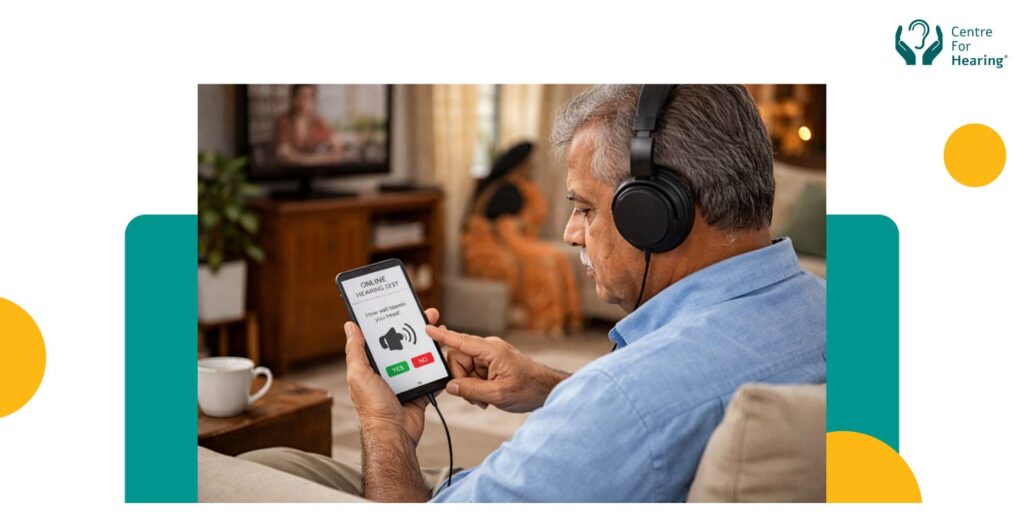
None of the above means online tests are worthless. They have a specific and genuinely useful role: getting people to act.
Hearing loss tends to develop gradually, and most people don’t notice it happening. They adapt. They start sitting closer to the television, choosing quieter restaurants, asking colleagues to repeat themselves. By the time the loss becomes obvious, it’s often been progressing quietly for years.
An online test can interrupt that pattern. If someone scores poorly on a quick screening, it creates urgency that a vague sense of “my hearing might be getting worse” doesn’t. That’s valuable. In audiology practice, it’s well-documented that people tend to wait far longer than they should before seeking help for hearing difficulty. By most estimates, that gap runs anywhere from several years to over a decade. Anything that shortens that gap is a good thing.
A reasonable way to think about it: an online hearing test is like checking your blood pressure at a pharmacy kiosk. Informative enough to tell you whether you should see a doctor, but nowhere near sufficient as a substitute for seeing one.
Centre for Hearing® offers its own free 3-minute online hearing screener.
It’s a practical way to check in on your hearing from home. If the result gives you cause for concern, the next step is booking a clinical evaluation.
So once that flag is raised, the next question is: what does a proper evaluation actually involve?
What a Proper Hearing Evaluation Covers
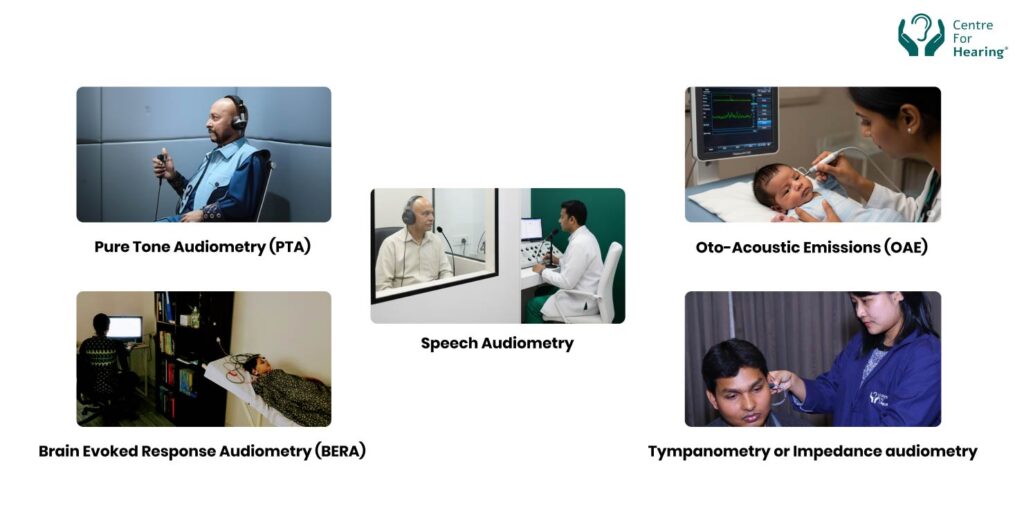
When you visit an audiology clinic for a proper hearing evaluation, the process is considerably more thorough than most people expect. At Centre for Hearing®, our RCI-certified audiologists conduct a structured assessment that typically includes:
- Pure Tone Audiometry (PTA): The gold-standard hearing test, conducted in a soundproof booth with calibrated equipment. This produces an accurate audiogram showing your hearing thresholds across frequencies.
- Tympanometry: Tests middle ear function to identify problems like fluid behind the eardrum or Eustachian tube dysfunction, which can mimic or contribute to hearing loss.
- Oto-Acoustic Emissions (OAE): Test the outer hair cells of the cochlea. Particularly important when there’s a question about sensory versus neural hearing loss.
- Speech Audiometry: Assesses how well you can understand speech at different volume levels, which is essential for selecting the right hearing aid and setting appropriate targets.
- Real Ear Measurement (REM): Used during the hearing aid fitting process to verify that the device is actually delivering the right amplification in your ear canal, not just on the bench.
This combination of tests typically takes under an hour and gives the audiologist a detailed picture of your hearing, not just a pass/fail score.

Not sure where your hearing stands? Take the Centre for Hearing®’s free online hearing screening.
Take Centre for Hearing®’s free 3-minute online hearing screener.
If the result raises any concern, our RCI-certified audiologists are available for a comprehensive clinical evaluation at no charge.
📞 +91 9811 227 269 | Home visit facility also available.
What to Do After an Online Hearing Test
If your result comes back normal, don’t assume your hearing is perfectly fine. Online tests are poor at detecting mild losses and can’t assess speech clarity, which is often where early hearing difficulty first shows up. If you’ve been noticing any symptoms, particularly difficulty following conversations in groups, a persistent ringing in your ears, or having to turn the volume up on your devices, book a proper evaluation anyway.
If your result suggested some degree of hearing difficulty, treat it as a reason to act, not a diagnosis. Schedule a comprehensive hearing test with a qualified audiologist who can tell you what’s actually happening, what’s causing it, and what your options are.
At Centre for Hearing®, we’ve been providing hearing evaluations and fitting internationally recognised hearing aid brands — including Phonak, Signia, Widex, ReSound, and Oticon — since 1973. Our clinics across Delhi NCR, Gurugram, Chandigarh, Ludhiana, Patiala, and Jalandhar are equipped with European manufacturer diagnostic equipment and staffed by RCI-certified audiologists. The first consultation is free.
📞 Book a FREE Hearing Consultation at Centre for Hearing®
If an online test has raised any concern, or if you’ve simply been meaning to get your hearing checked, take the next step with a proper clinical evaluation. Call us at +91 9811 227 269 or visit your nearest Centre for Hearing® clinic. Home visit facility also available.
Frequently Asked Questions
Are online hearing tests accurate?
Results vary depending on your environment and the device you use. A well-designed screener, like Centre for Hearing®’s free 3-minute online hearing screener, can give you a useful indication of whether your hearing warrants professional attention. What it can’t do is diagnose, identify the type of hearing loss, or replace a clinical evaluation. Treat the result as a prompt to act, not a final answer.
Can an online hearing test tell me what type of hearing loss I have?
No. Identifying the type and origin of hearing loss requires a combination of tests, including Tympanometry and OAE, that can only be conducted in a clinical setting with proper equipment.
My online test said my hearing is fine, but I still struggle. Should I still see an audiologist?
Yes. Online tests miss mild losses and typically don’t assess speech clarity. If you’re experiencing symptoms, a clinical evaluation is worth doing regardless of your online test result.
How often should I get a proper hearing test?
Most audiologists recommend a baseline test for adults over 50, and annual check-ups for anyone above 60. If you’re exposed to occupational noise, have a family history of hearing loss, or notice any change in your hearing, don’t wait for an annual check.
Is a clinical hearing test expensive?
At Centre for Hearing®, the first consultation is free, and it includes a comprehensive hearing evaluation. Our audiologists will walk you through your options at every stage, without any pressure.